The book · Second edition, September 2026
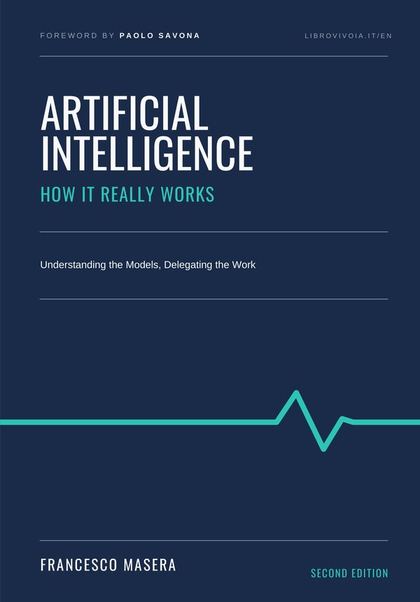
Artificial Intelligence
How It Really Works
Understanding the Models, Delegating the Work
No programming or mathematics required. Neural networks, language models, agents, and what any of it changes for the organisation you work in.
Print, 279 pages · Kindle ebook · 13 chapters in 5 parts, 17 technical appendices · Foreword by Paolo Savona
Inside the book
Five parts, thirteen chapters
Open a chapter to see its sections. Page numbers refer to the print edition.
Part I
Understanding
Chapter 1 · page 25Where the AI you use every day comes from
- The birth of AI
- Where we are today
Chapter 2 · page 31How a machine learns
- Symbolic AI: expert systems
- Machine learning: learning from data
- Traditional machine learning: the toolbox
- Deep learning: the leap in quality
- Artificial neural networks: basic architectures
- Artificial neural networks: advanced architectures
Chapter 3 · page 69Large language models
- How a language model is trained
- Big is not always better: efficient models
- New techniques for improving the capabilities of LLMs
- Who makes LLMs, and how they release them
- The architectures, in chronological order
Chapter 4 · page 83What sits around the model
- Adapting a model to your own material
- The context window
- Capacity and attention
- The harness: the set-up around the model
Part II
How to use LLMs
Chapter 5 · page 95Getting what you need
- Prompt engineering: how to talk to models
- When the chat fills up
- The memory of LLMs
- How to make the AI remember you
Chapter 6 · page 103From assistant to agent
- What “Agentic AI” means
- The four pillars of Agentic AI
- Challenges of Agentic AI: autonomy, security and responsibility
- Controlling agents: architectures, limits and supervision
- From episodic agents to long-running agents
- Attention as a scarce resource: multi-agent systems
- Who builds agents, and with what idea
Chapter 7 · page 117When the model gets it wrong
- When AI invents: the problem of hallucinations
- When AI agrees with you: sycophancy
- When AI does the sums: a problem of meaning
Part III
Towards business use
Chapter 8 · page 127Choosing and governing a solution
- The first question: what does the system really have to do?
- The second question: which data, and how to handle them?
- The third question: where should the model run?
- What is on the market
- Governing and integrating the system
Chapter 9 · page 139Redesigning your own work
- Using and redesigning
- Taking the process apart into activities
- Which activities stand up to delegation
- What you measure
- Who verifies, and what
- The data that do not leave
- When the error arrives
- The process is not only yours
- Delegating to an agent
- Four processes taken apart
- What stays yours
Part IV
Governing
Chapter 10 · page 165The risks that concern you
- When an algorithm decides: discrimination and bias
- Responsibility: who answers before the law
- The illusion of human control
- Making AI understandable: how to explain a decision
- Privacy and surveillance
Chapter 11 · page 173The rules
- European Union
- United States
- United Kingdom
- China
- Italy
- Towards a global approach
- The obligation that concerns you, and how it is met
Part V
Looking ahead
Chapter 12 · page 183Who owns artificial intelligence
- Capital: algorithms, patents and who does the training
- The data nobody can copy
- The machines money does not buy
- Who decides: the sum, the shelf, the states
- The bill: energy and water
Chapter 13 · page 193Where it is heading
- Biotechnology: the proof that it does real work
- Robotics: AI off the screen
- Weapons and conflicts: autonomy where it costs most
- Towards artificial general intelligence
- What nobody has decided yet
And at the back
The conclusion, “From Monday morning”, 17 technical appendices for readers who want the mathematics and the code, a glossary and the bibliography.
Why it rewrites itself
A book about AI is a map of how the technology works, which changes over years, and a picture of what is currently the case, which changes weekly. The map stays in print; the rest lives online, and what proves durable goes into the next edition.
Read the manifestoIn practice: coming soon
From Chat to Delegation, the book's practical guide to using Claude, ChatGPT and Copilot at work, from the first chat to a task handed over in full. I'm writing it now.
What it will coverAlready read it?
A short review on Amazon helps the next reader decide. Two lines are enough.
Leave a review